Menu
Moving
Residential MovingHouse MovingApartment MovingCondo MovingStudio Apartment MovingSmall MovesShared AccommodationWhite Glove MovingFamily MovingSenior MovingStudent MovingLocal MovingSame-Day MovingLong Distance MovingInternational MovingEconomical MovingEco-Friendly MovingJunk RemovalMoving LabourFurniture & Appliance DeliveryFurniture HoistingMove CoordinatorMoving InsuranceCommercial
Commercial MovingOffice MovingCorporate RelocationRetail Store MovingRestaurant MovingHotel MovingTrade Show MovingDelivery & DistributionBusiness StorageIndustrial MovingWarehouse MovingMedical Office MovingIT Equipment MovingSchool & College MovingLibrary MovingGovernment Office MovingSpecialty
Specialty Item MovingPiano MoversSafe MovingPool Table MovingGym Equipment MovingHeavy Item MovingAntique MovingFine Art MovingElectronics MovingLaboratory MovingCustom CratingPacking
Packing ServicesFull PackingPartial PackingFragile Item PackingUnpacking ServiceMoving Boxes & SuppliesPlastic Bin RentalWardrobe BoxesFurniture AssemblyStorage
Storage MontrealShort-Term StorageLong-Term StorageClimate-Controlled StorageFurniture StorageDocument StorageBusiness StorageOvernight Truck StorageCompany
About UsMontreal MoversMoving Tips BlogMoving Cost CalculatorGet a QuoteCall (514) 458-7786LavalLongueuilBrossardWest IslandSouth ShoreNorth ShoreTerrebonneMontreal to Quebec CityMontreal to OttawaMontreal to TorontoAcross CanadaInternationalIndustrial movers in Montreal for plants, workshops and machinery
Google reviews
Yelp reviews
Trustpilot reviews
Facebook reviews
Industrial moving in Montreal, planned around production

An industrial move is one of the most demanding projects a business can take on. Machines are heavy and expensive, production schedules are tight, and every day a line is stopped means missed orders. Unlike an office move, an industrial relocation involves weight calculations, floor loads, rigging decisions and careful coordination with electricians, millwrights and equipment technicians.
Déménagement NST Moving & Storage helps manufacturers, workshops, print shops, fabrication businesses and light industrial companies relocate across Greater Montreal. Our industrial movers handle the moving, loading and transport of machinery, workbenches, tooling, parts inventory, racking and office areas, and we work with your technical partners on disconnection and reconnection.
Every industrial project starts with a detailed site survey. Your coordinator documents each machine, its approximate weight and dimensions, the path out of the building and the path into the new one. From there we build a step-by-step plan and a guaranteed flat-fee quote, so you know exactly what the move will cost before work starts.
What our industrial moving service covers
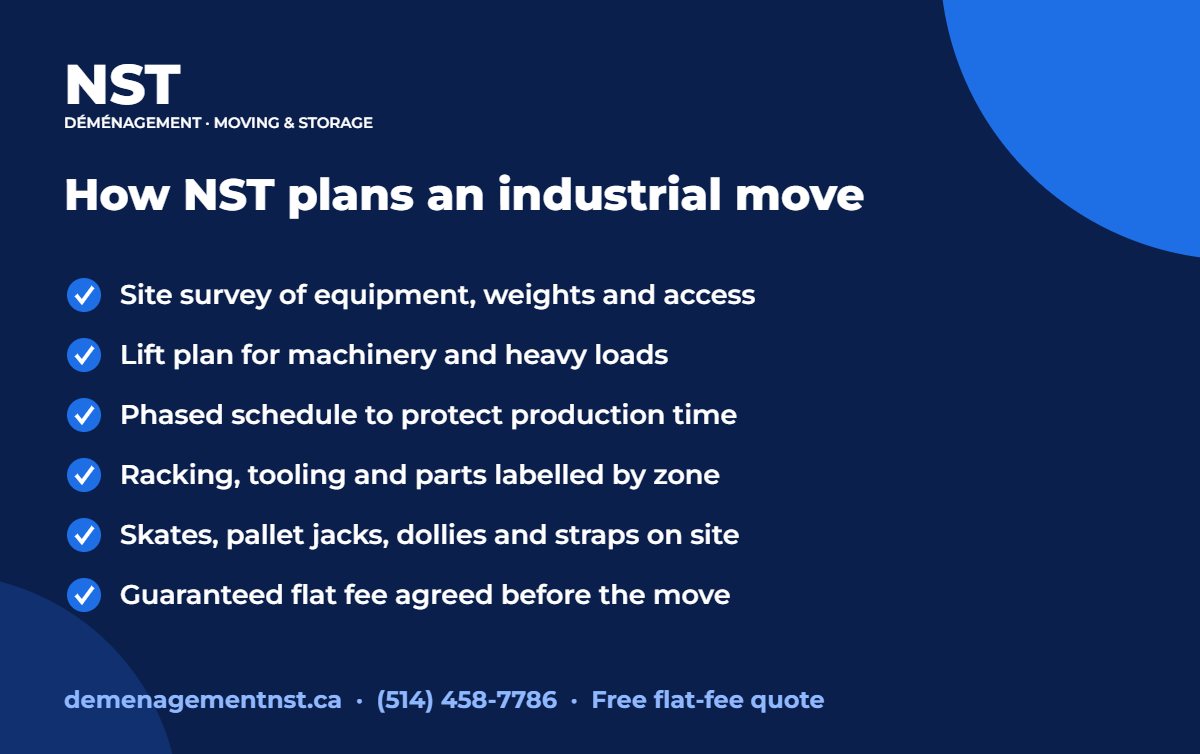
- Light and medium machinery: CNC equipment, lathes, presses, saws, compressors, printing equipment and packaging machines, moved with skates, pallet jacks and the right lifting equipment.
- Workbenches and tooling: tool cabinets, benches, jigs and fixtures, packed and labelled so your teams can start work quickly.
- Parts and inventory: pallets and bins of raw materials, components and finished goods, tracked by zone and location.
- Racking and shelving: dismantling, transport and reinstallation of pallet racking and industrial shelving. See also our warehouse moving service.
- Offices and break rooms: the administrative side of your plant, handled like any office move.
- Storage: short or long-term storage for surplus equipment, spare parts or inventory between sites.
For very large or specialised machinery that requires cranes or certified riggers, we coordinate with your chosen rigging partner and handle the rest of the move around them.
Our industrial relocation process
- Equipment survey. We list every machine and heavy item, with weights, dimensions and any special handling notes from the manufacturer.
- Access review. We check doors, ramps, loading docks, floor conditions and ceiling heights at both sites, and note anything that needs to be removed or reinforced.
- Move plan. Equipment is grouped into phases based on your production priorities. Critical machines can move first so they are back online quickly.
- Disconnection. Your electricians or technicians disconnect power, air and fluids. Machines are drained, cleaned and secured according to manufacturer guidance.
- Loading and transport. Our crew moves equipment with skates, pallet jacks and straps, blocks and braces loads in the truck, and drives them directly to the new site.
- Placement. Machines are set on the floor positions marked on your new layout, ready for levelling and reconnection by your technical team.
- Inventory and racking. Racking is reinstalled and inventory is returned to labelled zones so picking and production can resume.
Reducing lost production time
The goal of every industrial move is to get production running again as fast as possible. We use several strategies to protect your output.
Phase by priority. We move the equipment you need most first, so revenue-generating lines restart while secondary equipment follows.
Prepare the new site. Floor markings, power drops and compressed air lines should be in place before the first machine arrives. We share a checklist with your facilities team.
Move outside shifts. Evening, overnight and weekend moves let you produce right up to the last moment.
Build stock ahead. Many manufacturers build extra inventory before the move to keep shipping during the transition. We can store that stock and deliver it to customers or to the new site on schedule.
Safety on industrial moves
Heavy equipment demands respect. Our crews follow safe lifting practices, use the right equipment for each load and never take shortcuts with weight. Before moving a machine, we confirm it is fully disconnected, drained and secured. Loads are strapped, blocked and braced in the truck to prevent shifting, and walkways are kept clear for everyone working on site.
We work alongside your health and safety representative, follow your site rules and personal protective equipment requirements, and coordinate with other contractors so that electricians, riggers and movers are never in each other’s way.
What determines the cost of an industrial move
| Factor | Why it matters |
|---|---|
| Number and weight of machines | Heavier and larger equipment needs more crew, special tools and careful loading. |
| Distance and access | Loading docks, ramps, doors and floor conditions at both sites change how long each item takes. |
| Racking and shelving | Dismantling and reinstalling racking adds labour and planning. |
| Inventory volume | The number of pallets and bins affects truck loads and time. |
| Phasing and timing | Overnight, weekend and multi-phase schedules are planned around your production. |
| Third-party trades | Rigging, electrical and technical work is coordinated as part of the plan. |
| Storage needs | Equipment or stock stored between sites is quoted separately and clearly. |
You will receive a guaranteed flat fee before the move, based on the survey. Use our moving cost calculator for a first idea, then contact us for a site visit.
Industrial areas we serve
We move industrial businesses throughout Greater Montreal, including Saint-Laurent, Anjou, Saint-Léonard, Montréal-Est, Lachine, LaSalle, Dorval, Pointe-Claire, the Saint-Michel and Rosemont industrial corridors, Laval’s industrial parks, Boucherville, Longueuil, Saint-Hubert, Terrebonne and Mirabel. We also move equipment between Montreal and other cities in Quebec and Ontario.
Preparing your facility for the move
- Map the new layout. Mark the final position of each machine on the floor and share the plan with our coordinator.
- Book technical partners. Schedule electricians, plumbers and equipment technicians for disconnection and reconnection.
- Clean and drain. Remove fluids, coolant and loose parts from machines, and secure moving components.
- Sort inventory. Use the move to clear obsolete stock and scrap material so you only move what you need.
- Label everything. Tag machines, tooling and racking components with their destination zone.
- Plan communications. Tell customers and suppliers about the move dates and any short pause in shipping.
Why manufacturers choose NST
- A single coordinator who understands production priorities.
- A guaranteed flat fee instead of open-ended hourly billing.
- Licensed and insured movers, with certificates of insurance available for your landlord.
- Trained crews equipped with skates, pallet jacks, dollies and heavy-duty straps.
- Flexible scheduling 7 days a week, including nights and weekends.
- Storage, packing and office moving from the same team. See all our commercial moving services.
Industries and facilities we relocate
Industrial moving covers a wide range of businesses, and each one has its own priorities.
Machine shops and fabrication. CNC mills, lathes, band saws, welders and tool cabinets need careful handling and accurate placement so your machinists can get back to work. Tooling is packed by machine so setups are faster at the new shop.
Print and packaging. Presses, cutters, folders and finishing equipment are heavy and sensitive to vibration. We plan routes, protect delicate components and coordinate with your service technicians.
Food production and commercial kitchens. Mixers, ovens, stainless steel tables and refrigeration units are moved with hygiene in mind and kept protected throughout.
Woodworking and cabinet shops. Table saws, planers, dust collection systems and large workbenches are dismantled, moved and placed according to your new workflow.
Assembly and light manufacturing. Workstations, conveyors, testing equipment and parts inventory are moved by line, so each cell can restart independently.
Labs and technical workshops. For sensitive instruments and testing equipment, see our laboratory moving approach and ask your coordinator about custom crating.
Choosing the right moving sequence
The order in which equipment moves can make the difference between a two-day pause and a two-week slowdown. We usually recommend this sequence:
- Non-essential items first. Spare parts, archived files, unused equipment and seasonal stock move early, often during normal production weeks.
- Support infrastructure. Racking, workbenches, tool storage and office areas follow, so the new site is ready to receive equipment.
- Secondary machines. Equipment that is used less often moves next.
- Critical production equipment. Your most important lines move last from the old site and are placed first at the new one, with technicians ready to reconnect.
- Final clean-out. Leftover items, scrap and materials for recycling are removed so the old site can be returned to the landlord.
Your coordinator will adjust this sequence to your specific operation and confirm it in writing.
Working with riggers, electricians and technicians
An industrial move is a team effort. Riggers handle crane lifts and very heavy loads, electricians manage power disconnection and reconnection, plumbers deal with water and compressed air, and manufacturer technicians calibrate sensitive equipment. NST coordinates the moving side of the project around these partners. We share our schedule with every trade, confirm who is responsible for each step and make sure the right people are on site at the right time. That keeps the project safe, avoids waiting time and protects your equipment warranties.
After the move: restarting production
Once machines are in place, your technicians level, reconnect and test each one. We recommend a short commissioning checklist for every machine: power and air connected, safety guards in place, calibration checked and a test run completed. Keep our crew lead’s number handy during the first days, because small layout changes are common once production restarts. We can return to shift a workbench, rack or machine a few metres, collect empty crates and pallets, and bring stored equipment from our facility when you are ready for it.
Industrial moving FAQs
Can you move heavy machinery?
Yes. We move light and medium machinery with skates, pallet jacks and lifting equipment. For very heavy items that need cranes or certified riggers, we coordinate with your rigging partner as part of the plan.
Do you disconnect and reconnect machines?
Disconnection and reconnection of power, air and fluids should be done by your electricians or equipment technicians. We schedule around them and handle the physical move.
Can you move racking and shelving?
Yes. Our crews dismantle pallet racking and shelving, transport it and reinstall it at your new site according to your layout.
How do you keep production running during the move?
We move in phases based on your priorities, work evenings and weekends, and can store buffer inventory so you keep shipping during the transition.
How is an industrial move priced?
After a site survey, you receive a guaranteed flat fee based on equipment, inventory, access, timing and any coordination with other trades.
Do you offer storage for equipment?
Yes. We can store surplus machinery, spare parts and inventory in secure storage between sites.
How early should we plan?
For most industrial moves, start planning two to three months ahead so equipment can be surveyed and trades scheduled.
Can you move equipment between cities?
Yes. We move industrial equipment and inventory between Montreal and other cities in Quebec and Ontario, with the same planning and flat-fee pricing.
Do you remove old equipment we no longer need?
We can help you separate equipment to keep, store, sell or recycle, so you only move what you will use at the new site.
Plan your industrial move with NST
Share your equipment list, both addresses and your production deadlines. We will survey the site and build a phased plan with a guaranteed flat fee.
Call: (514) 458-7786 · Visit: 433 Jarry St W #201, Montreal, QC H3N 1E7
Request your industrial moving quote and keep production moving.
Related commercial moving services in Montreal
Every business move is different. Explore the other commercial moving services our Montreal crews provide:
MAKE YOUR MOVE!


Follow us on Instagram for promo codes and news
Residential Moving
Commercial Moving
Specialty & Packing
Storage
Resources
© 2026 Déménagement NST Moving & Storage.
All Rights Reserved.
Website developed by Aazz Agency UK & Aazz Agency
- 433 Jarry St W #201, Montreal, QC H3N 1E7
- (514) 458-7786
- info@demenagementnst.ca