Menu
Moving
Residential MovingHouse MovingApartment MovingCondo MovingStudio Apartment MovingSmall MovesShared AccommodationWhite Glove MovingFamily MovingSenior MovingStudent MovingLocal MovingSame-Day MovingLong Distance MovingInternational MovingEconomical MovingEco-Friendly MovingJunk RemovalMoving LabourFurniture & Appliance DeliveryFurniture HoistingMove CoordinatorMoving InsuranceCommercial
Commercial MovingOffice MovingCorporate RelocationRetail Store MovingRestaurant MovingHotel MovingTrade Show MovingDelivery & DistributionBusiness StorageIndustrial MovingWarehouse MovingMedical Office MovingIT Equipment MovingSchool & College MovingLibrary MovingGovernment Office MovingSpecialty
Specialty Item MovingPiano MoversSafe MovingPool Table MovingGym Equipment MovingHeavy Item MovingAntique MovingFine Art MovingElectronics MovingLaboratory MovingCustom CratingPacking
Packing ServicesFull PackingPartial PackingFragile Item PackingUnpacking ServiceMoving Boxes & SuppliesPlastic Bin RentalWardrobe BoxesFurniture AssemblyStorage
Storage MontrealShort-Term StorageLong-Term StorageClimate-Controlled StorageFurniture StorageDocument StorageBusiness StorageOvernight Truck StorageCompany
About UsMontreal MoversMoving Tips BlogMoving Cost CalculatorGet a QuoteCall (514) 458-7786LavalLongueuilBrossardWest IslandSouth ShoreNorth ShoreTerrebonneMontreal to Quebec CityMontreal to OttawaMontreal to TorontoAcross CanadaInternationalLibrary movers in Montreal who keep every book in order
Google reviews
Yelp reviews
Trustpilot reviews
Facebook reviews
Library moving in Montreal, one shelf at a time
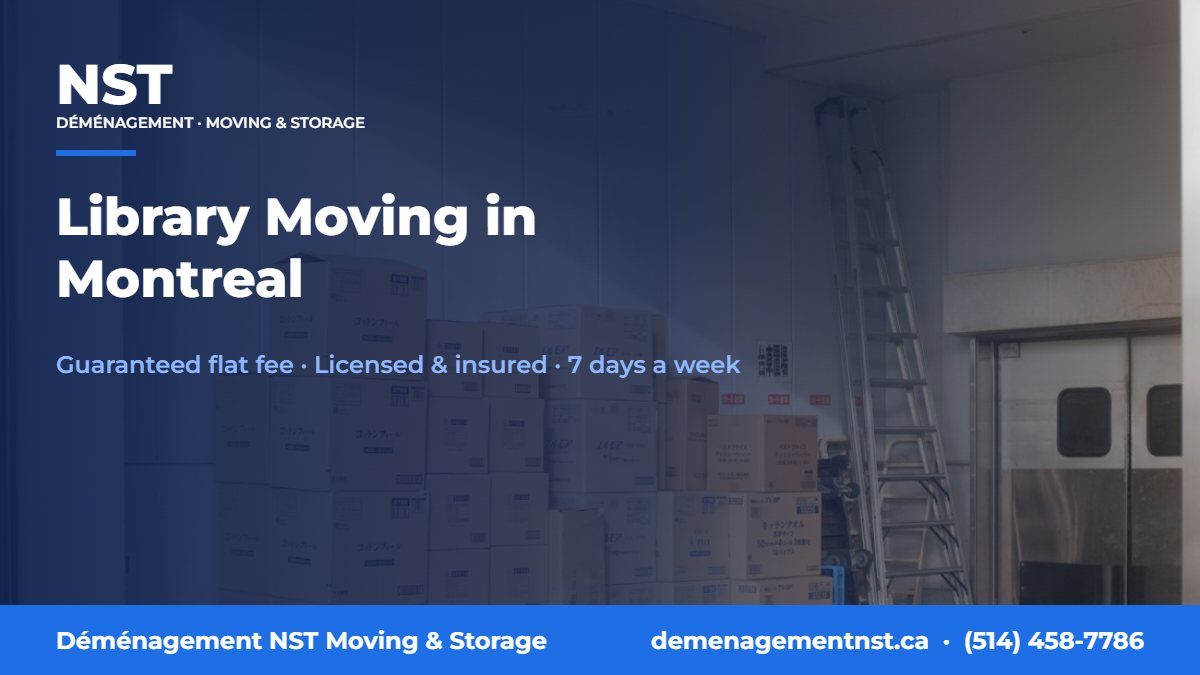
A library is one of the most organised spaces in any building, and a move must keep it that way. Tens of thousands of books, journals, archives, maps and media have to leave their shelves in order, travel safely and return to new shelves in exactly the same sequence. A single mixed-up cart can take staff days to correct. That is why library moving needs a method, not just muscle.
Déménagement NST Moving & Storage moves public libraries, school and college libraries, university collections, law firm and corporate libraries, religious and community libraries and private collections across Greater Montreal. Our library movers use numbered carts or cartons, follow your shelf map and work closely with your librarians from planning to reshelving.
Every project is led by a dedicated coordinator who surveys the collection, measures linear shelf space at both locations and builds a moving plan with your team. You receive a guaranteed flat-fee quote before the work begins.
What we move in a library relocation
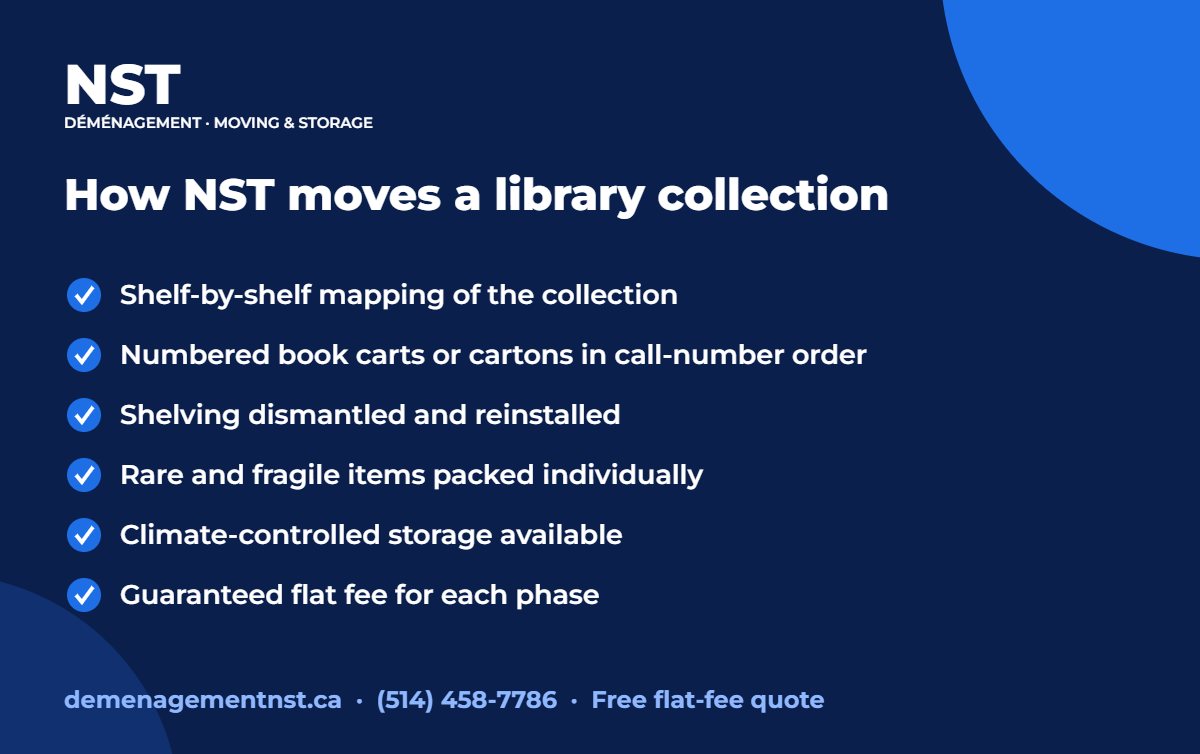
- General collections: books in call-number order, moved on numbered carts or in numbered cartons.
- Periodicals and reference: bound journals, encyclopedias and heavy reference sets.
- Special collections: rare books, manuscripts, maps and archival boxes, packed individually or in custom crates.
- Media: DVDs, CDs, microfilm and audio-visual collections.
- Shelving: steel shelving, wooden bookcases, compact mobile shelving components and display units.
- Furniture: reading tables, study carrels, circulation desks, chairs and lounge seating.
- Technology: public computers, self-checkout stations, printers and staff workstations. See IT equipment moving.
- Offices and workrooms: staff areas, processing rooms and archives.
Our library moving method
- Collection survey. We measure the collection in linear metres or feet and note special formats and fragile items.
- Shelf mapping. With your librarians, we map where each range of the collection will go in the new space, including room for growth.
- Numbering system. Each cart or carton gets a number in sequence. Labels show the call-number range and destination range.
- Packing order. Books are removed from shelves in order and placed on carts or in cartons the same way, spine up or spine out as agreed.
- Shelving. Where shelving is moving too, it is dismantled after the books are removed and reinstalled at the new site before books arrive.
- Transport. Carts are wrapped and secured, or cartons are loaded in numbered sequence.
- Reshelving. Books are returned to new shelves in sequence, either by our crew or by your staff, following the map.
Book carts or cartons?
Book carts are ideal for moves within a building or short distances between buildings. Books stay on their spines, are easy to keep in order and can be reshelved quickly. Carts are wrapped in stretch film so books cannot fall during transport.
Cartons suit longer moves, moves to storage and collections that need extra protection. Books are packed flat or spine-down in sequence, and each carton is numbered.
Many projects use both: carts for the general collection and cartons or crates for special collections and storage.
Protecting rare books and archives
Rare and fragile materials need extra care. We pack them individually with acid-free tissue or wrapping provided by your conservation team, in padded boxes or custom crates. Oversized maps and prints travel flat in folders or crates. These items can travel separately, in a dedicated vehicle or at a dedicated time, under the supervision of your staff. If materials need to be stored during a renovation, our climate-controlled storage protects them from temperature swings and humidity.
Library moving costs
| Factor | Why it matters |
|---|---|
| Size of the collection | Linear metres of material is the main driver of time and crew size. |
| Shelving | Dismantling and reinstalling shelving adds labour and coordination. |
| Special collections | Rare, fragile or oversized materials need individual packing. |
| Carts or cartons | Equipment and materials depend on the moving method. |
| Access | Elevators, stairs, ramps and distance to the truck. |
| Reshelving | Whether our crew or your staff reshelve the collection. |
| Storage | Collections stored during construction or renovation. |
Each phase is quoted as a guaranteed flat fee after the collection survey.
Planning tips for librarians
- Weed before you move. Deselecting outdated or damaged materials reduces moving time and cost.
- Measure carefully. Compare collection size with new shelf capacity and plan space for growth on each shelf.
- Update signage and catalogue locations. Plan new range signs and update locations in your system before reopening.
- Communicate with patrons. Announce closure dates, interim services and the reopening date well in advance.
- Plan returns. Decide where book drops will go during the move and how holds will be handled.
Types of libraries we move
Public and municipal libraries often move during renovations or into new buildings, with large general collections and children’s areas. School and college libraries move during breaks and must be ready for the new term. University libraries include research collections, special collections and archives across several floors or buildings. Law firm and corporate libraries combine collections with confidential files and are usually moved over a weekend. Private collections in homes and studies are packed with the same care and numbering system.
Moving archives and records rooms
Many libraries share space with archives and records rooms. Archival boxes are moved in numbered sequence, and confidential records can travel in sealed or locked containers under supervision. For organisations that need off-site space, our document storage options keep files secure until you need them back. We document what was moved and where it was placed, so your archivists can confirm every series has arrived.
Areas we serve
We move libraries and collections throughout Montreal, Laval, Longueuil and the surrounding region, including campuses in Downtown Montreal, Côte-des-Neiges, Outremont and the West Island, and public libraries across the island’s boroughs and neighbouring cities.
Why libraries choose NST
- A proven numbering system that keeps collections in order.
- Careful handling of rare and fragile materials.
- Shelving dismantling and reinstallation.
- Guaranteed flat-fee pricing per phase.
- Licensed and insured movers with trained, respectful crews.
- One coordinator working closely with your librarians. See our school moving and commercial moving services.
Measuring a collection: linear metres explained
Library moves are planned in linear metres or feet, the total length of shelf space the collection occupies. To measure, count the number of shelves in use in each range and multiply by the shelf width, then adjust for shelves that are only partly full. Our coordinator does this during the survey, but your own counts help with planning.
Knowing the size of the collection lets us estimate how many carts or cartons are needed, how many truckloads the move will take and how long it will last. It also lets your librarians check that the new space has enough shelf capacity. As a rule of thumb, leave some empty space at the end of each shelf in the new layout so the collection can grow without shifting every book along the range a year later.
Moving compact mobile shelving and special furniture
Compact mobile shelving, the kind that slides on rails to save floor space, is common in archives, law libraries and university storage areas. These systems are heavy and precise. Carriages, rails and shelving components must be dismantled in the right order, labelled and reinstalled on level rails at the new site. We work with your shelving supplier or installer when the system needs technical adjustment, and handle the removal and transport of components.
Circulation desks, reading tables, study carrels and display cases are often custom built and can be heavy and fragile. We measure them against doorways and elevators in advance, disassemble them where possible and wrap them carefully. Map cabinets and plan chests are moved with drawers secured or emptied, depending on their weight and contents.
Keeping services running during the move
Many libraries try to keep offering some services while the collection moves. Options include a temporary pop-up location with a small collection of popular titles, extended loan periods before the closure, digital services and interlibrary loans, and a clear plan for returns and holds. We can move a small temporary collection to an interim space and back again as part of the project.
During the move itself, we schedule work so that sections of the collection are unavailable for as short a time as possible. Sections can be moved and reshelved one at a time, so staff can begin reopening parts of the new library while the rest is still arriving.
Library moving timeline
Six to twelve months before: confirm the new space, measure the collection and plan shelving capacity.
Three to six months before: weed the collection, book movers, design the shelf map and plan signage.
One to three months before: update catalogue locations, communicate with patrons and plan interim services.
Move period: pack, move and reshelve in sequence, phase by phase.
After the move: shelf-read sections, adjust signage and reopen.
Moving a private or home library
Collectors, academics and book lovers often have private libraries that are just as precious as an institutional collection. We pack home libraries in numbered boxes that follow the order of your shelves, so you can unpack shelf by shelf in the new home. Valuable first editions, signed copies and fragile bindings are wrapped individually, and heavy art books are packed flat in small boxes to protect their spines. Bookcases are emptied, wrapped and, where needed, disassembled. When you move house with us, your library can be part of a regular residential move, with the same careful system applied.
Library moving FAQs
How do you keep books in order?
We use numbered carts or cartons in call-number sequence, with labels showing both the old and new shelf ranges.
Can you move library shelving?
Yes. We dismantle steel and wooden shelving, transport it and reinstall it at the new location before books arrive.
Do you reshelve the books?
We can reshelve the collection following your shelf map, or deliver carts in order for your staff to reshelve.
Can you move rare books and archives?
Yes. Rare and fragile materials are packed individually, using materials approved by your conservation team, and can travel separately.
Can you store a collection during renovations?
Yes. We can store books, archives and shelving in secure, climate-controlled storage until the renovated space is ready.
How long does a library move take?
It depends on the collection size and access. Small libraries can move in a few days, while larger collections are moved in phases over several weeks.
How is a library move priced?
Each phase is quoted as a guaranteed flat fee based on collection size, shelving, special materials, access and storage.
Do you move compact mobile shelving?
Yes. We dismantle, move and reinstall mobile shelving components, working with your supplier when technical adjustment is needed.
Can part of the library stay open during the move?
Often, yes. We can move and reshelve the collection section by section, and move a small interim collection to a temporary location.
Plan your library move with NST
Share the size of your collection, your shelving and your timeline. We will build a numbered moving plan and a guaranteed flat-fee quote.
Call: (514) 458-7786 · Visit: 433 Jarry St W #201, Montreal, QC H3N 1E7
Related commercial moving services in Montreal
Every business move is different. Explore the other commercial moving services our Montreal crews provide:
MAKE YOUR MOVE!

Follow us on Instagram for promo codes and news
Residential Moving
Commercial Moving
Specialty & Packing
Storage
Resources
© 2026 Déménagement NST Moving & Storage.
All Rights Reserved.
Website developed by Aazz Agency UK & Aazz Agency
- 433 Jarry St W #201, Montreal, QC H3N 1E7
- (514) 458-7786
- info@demenagementnst.ca